

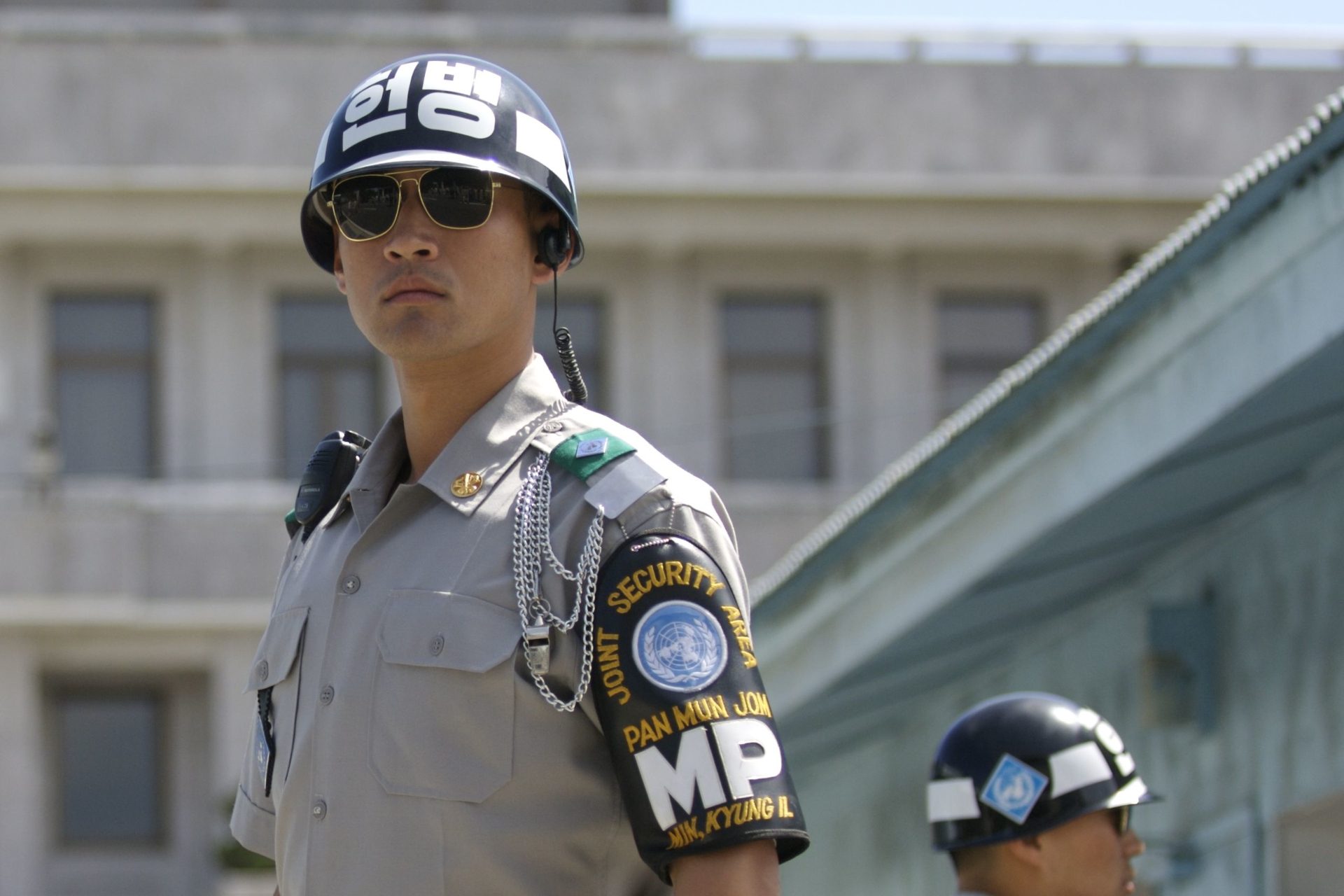
I’ve helped thousands of travelers to visit the Korean DMZ, and I can tell you exactly which moment makes people fall silent. It’s not the barbed wire or the watchtowers. It’s the instant they step into the Joint Security Area and realize they’re standing just feet away from North Korea, close enough to lock eyes with a soldier on the other side.
But to truly feel that moment, you need to understand the story behind it. So let me give you the history of the JSA, the way I’d tell it to you in person. No dusty textbook, just the parts that matter.
What Exactly Is the JSA?
The Joint Security Area is the only place along the 250-kilometer Korean border where North and South Korean forces stand face-to-face. Located within the village of Panmunjom, it sits inside the Demilitarized Zone (DMZ), the buffer that has separated the two Koreas since 1953.
Here’s what makes it extraordinary. Everywhere else along the border, the two sides are kept well apart. But in the JSA, they share the same small patch of ground. For decades, this was where soldiers from both nations could literally reach out and touch one another’s territory.
How It All Began: The Korean War and the 1953 Armistice
To understand the JSA, you have to rewind to the Korean War (1950 to 1953), a brutal three-year conflict that drew in forces from around the world and left the peninsula devastated.
The war never officially ended. Instead, on July 27, 1953, an Armistice Agreement was signed, halting the fighting and establishing the DMZ. Panmunjom was the site of those long, tense negotiations, and it became the designated meeting point for the two sides going forward. That’s how the Joint Security Area was born, a neutral ground for face-to-face contact.
I always remind my guests of this. Technically, the two Koreas are still at war. The Armistice was a ceasefire, not a peace treaty. That tension is what you feel in the air at the JSA.
The Moments That Shaped the JSA
A few key events transformed this place into the symbol it is today.
The 1976 Axe Murder Incident. Originally, soldiers from both sides could move freely throughout the JSA. That changed in August 1976, when a group of North Korean soldiers attacked a UN work party that was simply trimming a poplar tree obstructing the view. Two American officers were killed. In the aftermath, a Military Demarcation Line was drawn directly through the JSA, and the two sides were no longer allowed to cross into each other’s territory. The freedom of movement was gone for good.
Daring defections. The JSA has witnessed some of the most dramatic escapes in modern history. The most famous came in November 2017, when a North Korean soldier sprinted across the border under a hail of gunfire from his own comrades. He survived, and his escape was captured on camera, stunning the world.
A historic handshake. In April 2018, the JSA became a stage for hope. South Korean President Moon Jae-in and North Korean leader Kim Jong-un met here, and in an unscripted moment, briefly stepped together across the border line. For a place defined by division, it was a powerful image of possibility.
The Travis King incident. In July 2023, a US Army soldier named Travis King bolted across the border into North Korea while on a JSA tour, becoming the first American to do so in decades. He was eventually returned to US custody, but the incident sent shockwaves through the security community. As a direct result, tours to the JSA have been indefinitely suspended. At the time of writing, visitors are no longer able to enter the Joint Security Area itself.
The Blue Buildings Everyone Wants to See
If you’ve ever seen photos of the JSA, you’ve seen the row of pale blue buildings. These are the Military Armistice Commission (MAC) conference rooms, and they’re built directly on the Military Demarcation Line, so they straddle both countries at once.

Inside the main conference room, the border runs right across the negotiating table. When tours were running, this was the spot that made my guests grin like children. You could walk to the far side of the room and stand, technically and officially, in North Korea. Just a few steps, but a few steps that no other border crossing on earth can offer.
The JSA Today
The atmosphere at the JSA has always shifted with the political climate, and access has fluctuated over the years depending on relations between the two Koreas. Today, with tours suspended following the Travis King incident, the JSA is off-limits to visitors. What never changes, though, is the weight of the place. It remains one of the last living chapters of the Cold War, frozen in time.
Why This History Comes Alive in Person
You can read all of this in five minutes. But while direct JSA access is currently suspended, that doesn’t mean the story is closed to you.
At DGO Travel, we’re one of only two agencies in Korea with exclusive access to the JSA Museum, located within the DMZ. And this is no ordinary museum. Instead of glass cases and “do not touch” signs, it’s a fully immersive, interactive experience that puts you right inside the history I’ve just shared. You don’t simply read about the JSA here. You step into it, engage with it, and come away feeling like you’ve genuinely been there.
Even with the JSA itself closed to visitors, this is the deeper layer most travelers never get to see, and it’s the part my guests remember most.
If this short history stirred something in you, I’d love to show you the real story. Come explore the place where two worlds meet, and let us tell you the rest in person.